Buying a used car can be one of the smartest money decisions you make — or one of the most expensive mistakes. The difference usually comes down to what you notice before you hand over the money, not after.
The problem is that a used car's biggest issues are the ones you can't see on a quick test drive. A car can look spotless, drive smoothly, and still be hiding a rolled-back odometer, a skipped service history, or expired insurance you'll inherit. Sellers who want to hide something are good at hiding it.
Here are 7 red flags to check before you pay — and a simple way to know when a car is genuinely as good as it looks.
Used Car Inspection Checklist
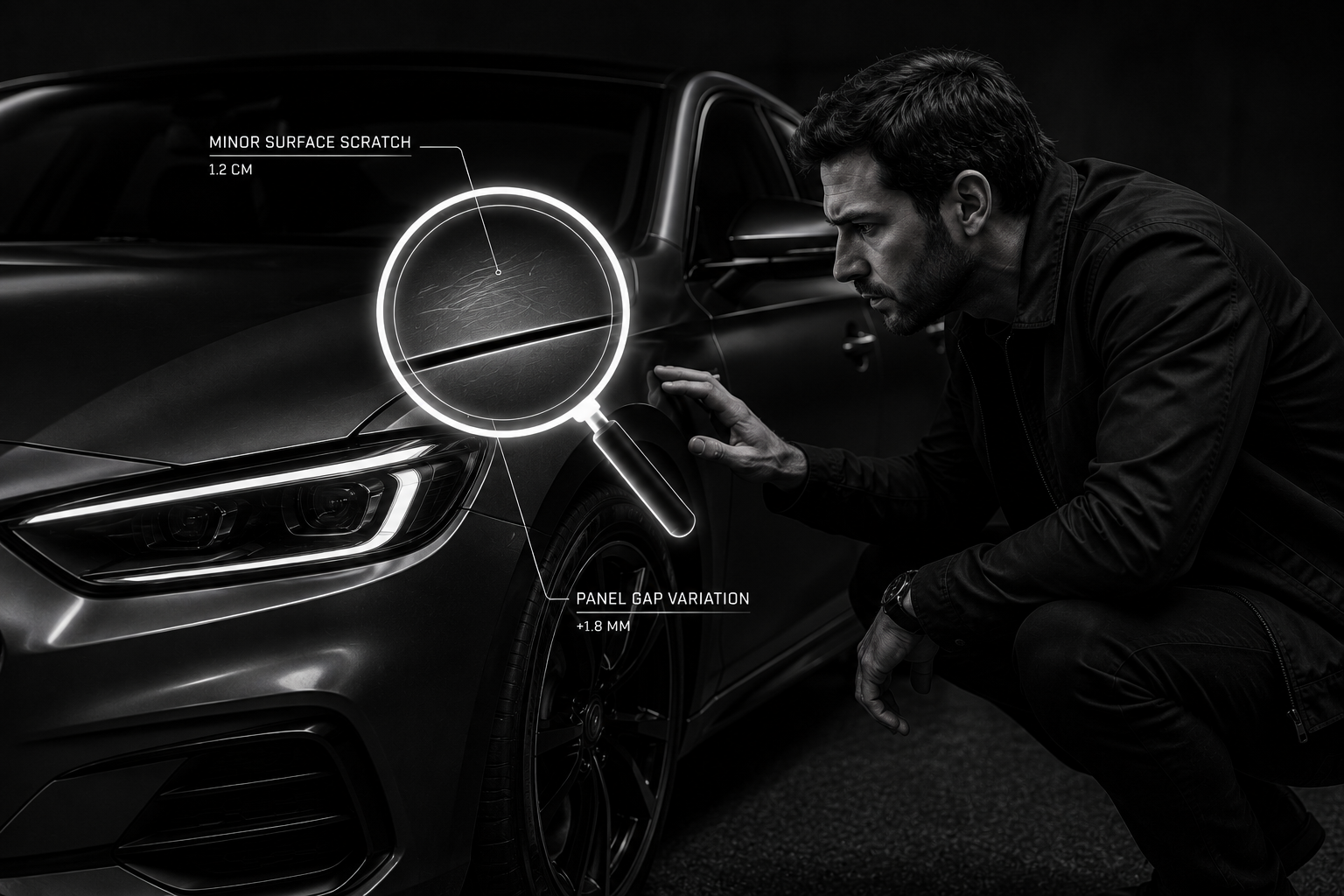
A buyer inspecting a used car at a dealership with visual indicators showing red flag checks.
1. An Odometer Reading That's "Too Good"
If a five-year-old car shows suspiciously low kilometres, be careful. Odometer tampering — rolling back the reading to make a car look less used — is common in the used car market, and it directly inflates the price you'll pay.
How to check: Compare the odometer against the car's overall wear — the pedals, the steering wheel, and the driver's seat. If the reading says 30,000 km but the car feels like 90,000 km, something is off. The strongest proof is a car with a verified odometer history you can actually see, not just a number on the dash.
2. No Service History
A seller who can't show you any service records is asking you to take a huge amount on faith. Was the oil changed on time? Were warning lights ignored? Was that strange noise ever looked at? Without records, you have no idea — and you're the one who will pay for whatever was neglected.
How to check: Ask for the full service history up front. A car with a complete, dated maintenance log is worth far more than an identical car with a shrug and "it was serviced regularly, trust me."
Verify Full Maintenance History
Buying or selling a car? Track complete service records, date-stamped logs, and oil changes in one place with Odo.
3. Missing or Mismatched Bills
Bills are the evidence behind the story a seller tells you. If they claim a major part was replaced last year, there should be a bill for it. If the repairs they describe don't match any paperwork — or there's no paperwork at all — treat the claims as unproven.
How to check: Ask to see bills for any major repairs or replacements the seller mentions. Genuine owners who cared for the car usually kept them.
4. Documents That Are About to Expire (or Already Have)
Insurance, PUC, and registration don't just vanish when you buy the car — you inherit them. A lapsed insurance policy or an expired PUC becomes your problem the moment money changes hands, and sorting it out costs time and fines.
How to check: Verify the expiry dates on insurance, PUC, and registration before agreeing on a price. If something is expired, factor the renewal cost into your offer.
Never Deal with Expired Papers
Store your RC, PUC, and Insurance policies in Odo to get automatic expiry reminders and instant document verification.
Verified Service Records for Used Car
A seller showing digital maintenance history logs on a mobile phone during a car inspection.

5. A Rushed or Evasive Seller
If a seller is pushing you to decide quickly, avoiding straight answers, or getting defensive when you ask for documents, that's a red flag in itself. Genuine sellers with a well-kept car are usually happy to prove it — because the proof works in their favour.
How to check: Ask direct questions about history, servicing, and documents. Watch how comfortable they are answering. Confidence backed by records is a good sign; vagueness is not.
6. Signs of Hidden Accident Repair
A car that's been in a serious accident can be made to look fine on the surface but hide structural or mechanical problems. These are the issues that cost the most later.
How to check: Look for mismatched paint, uneven panel gaps, or fresh underbody work. When in doubt, get a trusted mechanic to inspect it — a small inspection fee can save you from a very expensive mistake.
7. A Price That's Too Low to Make Sense
If a deal seems unusually cheap, ask why. Sometimes it's a genuine urgent sale. Often, it's a car with a problem the seller is quietly trying to move on before you notice.
How to check: Compare the asking price to similar cars. If it's far below market, don't just celebrate — investigate. A low price with no explanation is a warning, not a win.
The One Thing That Clears Every Red Flag
Read back through the list and you'll notice something: almost every red flag exists because the buyer can't verify the seller's claims. Fake odometer, missing history, unproven repairs, expired documents — they're all forms of the same problem: missing evidence.
So the fastest way to buy with confidence is to look for a car whose history can actually be shown, not just described. A car with a complete digital profile — verified odometer, full service log, scanned bills, and up-to-date documents — answers almost every question on this list before you even ask it.
That's the kind of car worth paying for. And if you're on the other side of the deal — the one selling — it's exactly the kind of profile that gets you a better price, faster.
Keep a Verifiable Vehicle Profile
Eliminate red flags. Build a complete digital profile for your car with Odo so the proof is always on your side.
Tags: buying a used car, used car checklist, car red flags, odometer tampering, car history, car buying tips